
Maria-Cristina Onea
Maria-Cristina Onea is a Romanian multidisciplinary contemporary artist based in London and a graduate of the Royal College of Art. Working across analogue photography, experimental sound, performance and light-based installation, her practice explores light as an active material, examining perception, memory, presence and absence. For RAW STATES の, curated by Marie Camara for off-RCA at Niche.Show London 2026, she develops Blue on Blue, an installation investigating material transformation, industrial energy and the fragile persistence of images.
-
Maria-Cristina Onea is a Romanian multidisciplinary artist based in London. She holds an MA in Photography from the Royal College of Art (2025) and a BA (Hons) in Fine Art Photography from the Glasgow School of Art (2023).
Working across analogue photography, sound, performance and light-based installation, Onea approaches light not simply as a means of producing images, but as an active material that can be shaped, interrupted and set in motion.
Her practice investigates the boundaries between photography and painting, exploring how images emerge through shadow, projection, reflection and the passage of time. Photography becomes a form of light-writing, recording transient encounters between bodies, objects and their environments.
Alongside her visual practice, Onea works with experimental sound, noise, field recording and live performance. Her sonic work extends her investigation of perception through vibration, duration and spatial experience.
Her work has been presented internationally, including at Rencontres d'Arles (2025), Liverpool Biennial (2025), the Royal College of Art (2025), Brompton Cemetery Chapel (2025) and CCA Glasgow (2022).
Across these disciplines, Onea explores the unstable relationship between material presence and disappearance, where light and sound become means of tracing what cannot be permanently held.
-
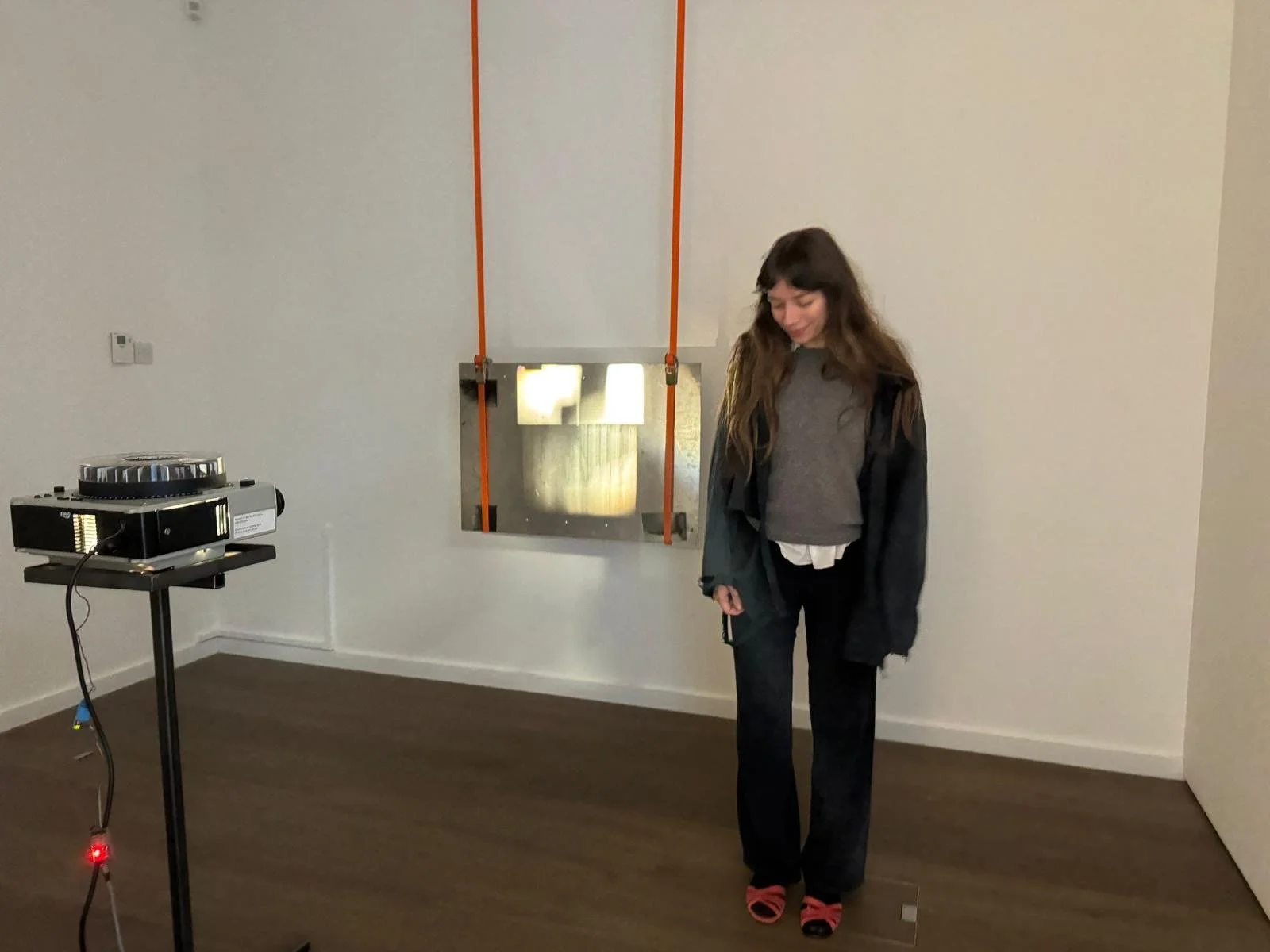
For RAW STATES の, Maria-Cristina Onea develops Blue on Blue (working title), an installation exploring the relationship between industrial materiality, human ambition and the fragile conditions that sustain an image.
A nocturnal shadow is projected onto a suspended sheet of rusting metal, bringing together the physical weight of matter and the fleeting presence of light.
The work examines the tension between endurance and disappearance. While metal records the passage of time through oxidation, the projected image remains dependent on an apparatus that must continually sustain it.
Drawing on the material histories of industrial production, Onea considers the transformations through which matter becomes energy, and the consequences of extraction, consumption and technological progress.
An olfactory element, conceived in collaboration with Misia-O’, extends this investigation through a gasoline-inspired scent associated with the structures supporting the installation.
Rather than functioning as an illustration, scent becomes another material presence, connecting the industrial processes of energy and combustion with the intimacy of bodily perception.
Through light, metal and scent, Blue on Blue explores the tension between aspiration and vulnerability, persistence and exhaustion, presence and absence.
-
BLUE ON BLUE
Working titleBlue on Blue brings the material histories of industrial modernity into contact with the fragile interior life of the individual.
A nocturnal shadow projected onto rusting metal becomes an image suspended between presence and disappearance.
The installation explores the relationship between light, gravity, energy and the material conditions required to sustain an image.
Its title evokes repetition, emotional exhaustion and the paradox of persistence: the desire to hold something in place despite the forces that continually transform it.
NOCTURNAL SHADOWS — BACKLIT WORKS
Proposed accompanying seriesA series of nocturnal shadow transparencies explores the transformation of photographic materials through time.
Originally printed in black, the images have gradually altered towards amber tones. When illuminated from behind, the aged surfaces acquire a flame-like luminosity.
What might ordinarily be understood as deterioration becomes a new visual condition, revealing the capacity of materials to change while retaining traces of their previous states.